
1707
Johann Georg Schmidt is the first to write it down: hot tourmaline pulls ash from the coals, like a magnet pulls iron.
How tourmaline, admired by Linnaeus and Empress Dowager Cixi, ended up in the chip of a pad just 1 mm thick
In brief
The first day of your cycle, eight in the morning. Work until evening ahead, a chill low in your belly, and your hand reaches for a hot mug all by itself. WHIEDA (Fohow) anion pads are made for a day like this. They're thin, just one millimetre, and their chip holds a stone with a biography. Three hundred years ago it baffled European scientists; a hundred years ago it adorned China's imperial court.
The word “tourmaline” sailed in from Ceylon. In Sinhalese, turamali means “mixed stones” — the island's name for gems that blend many colours (GIA). The Dutch East India Company shipped them to Europe by the batch, for collections and jewellery.
The Dutch soon noticed something odd. Put a crystal into warm ash, and it starts pulling the ash toward itself, the way a magnet pulls iron filings. Then it pushes it away. The stone was nicknamed aschentrekker, “ash puller”, and also the “Ceylon magnet” (Wikipedia). Legend has it that sailors used it to clean their pipes.
Then the scientists took on the stone (Wikipedia):
1707
Johann Georg Schmidt is the first to write it down: hot tourmaline pulls ash from the coals, like a magnet pulls iron.
1747
Carl Linnaeus, in his book on the plants of Ceylon, calls tourmaline lapis electricus — “the electric stone”.
1756
Franz Aepinus proves by experiment that it really is electricity.
1824
Scotsman David Brewster gives the phenomenon the name still used today — pyroelectricity. Electricity from heat.
1880
Pierre and Jacques Curie discover piezoelectricity: squeeze a crystal and it produces a charge. Tourmaline was among the first crystals they tested. Pierre was just 21. An instrument the brothers built on this effect later helped Marie Curie in her research on radioactivity. (Wikipedia)
Pronounced “dianqishi”, literally “electricity stone”. That's what tourmaline is still called in China (Chinese Wikipedia).
Empress Dowager Cixi adored pink tourmaline. From 1902 to 1910, San Diego County in California shipped about 120 tonnes of pink gems to China. They were carved into snuff bottles and jewellery for the court (Times of San Diego). In 1911–1912 the empire fell. And with it collapsed the American tourmaline market: its main buyer was gone.
In China the stone has a second, courtly name — 碧玺, “bixi”. It was used for officials' court beads and the finials of their hats.
According to the memoirs of Li Chengwu, nephew of the chief eunuch Li Lianying, a lotus carved from tourmaline was placed in Cixi's tomb. The flower weighed about a kilogram and was valued at 750,000 taels of silver (retelling of the memoirs). A tael weighed about 37.3 grams, so that's roughly 28 tonnes of silver.
The same stone that adorned Cixi's court now lies in the chip of a pad, right against your skin.
Around the year 200, Chinese physician Zhang Zhongjing wrote a short line in his treatise “Jingui Yaolüe”: 妇人少腹寒 — “a woman with cold in the lower belly”. And straight away he gave a warming recipe (text of the treatise). From this line grew the modern Chinese 宫寒, “cold womb”, and the saying 十女九寒: “nine women out of ten are cold”. Ever since, warmth in the lower belly has been cherished in China the way people protect their throat in winter.
Women reach for warmth on their own, no treatises needed. In Hong Kong, 240 female students were surveyed. The most common way to get through the hard days turned out to be a cup of something warm: 62% did that. It beat even paracetamol, at 57% (Hong Kong Medical Journal, 2013).
In an anion pad, that warmth stays close all day: the chip gives off gentle far-infrared warmth right where you want to protect yourself. It’s a tourmaline chip: the stone warms up from your body and holds the heat. Besides the stone and the warmth, the chip contains anions and nanosilver.
The pad itself has a shorter story: it's only a little over a hundred years old.
Until the 1920s, American women wore flannel “diapers” and washed them. The First World War changed everything. Kimberly-Clark supplied the army and the Red Cross with cellulose wadding for bandages. It absorbed five times better than cotton and cost half as much. Nurses at the front began using it for themselves on their period days (Kimberly-Clark's history of the pad).
After the war, the company bought back the army's surplus wadding. In October 1920 Kotex came out: 12 pads in a “hospital blue” box for 60 cents. One pad was 40 layers of wadding wrapped in gauze.
Many magazines refused to run the ads, and pharmacies didn't want to stock the product. So the boxes were put right on the counter, next to the cash box. A woman picked one up herself, paid in silence and didn't have to ask the clerk out loud. That's how the pad became one of the first self-service products in America (Wikipedia).
That's how many pads and tampons a woman uses in her lifetime: about 500 cycles over 38 years, around 22 per cycle. Calculation by the UK's Women’s Environmental Network (fact sheet). Each of them lies against the skin for hours.
Layers40 layers of wadding in gauze
Against the bodyGauze
What absorbsCellulose wadding
Chip—
Packaging12 pads in a blue box
Layers9 layers, 1 mm in total
Against the bodySoft cotton layer
What absorbsJapanese Sumitomo absorbent: moisture turns into gel
ChipTourmaline, warmth, anions, nanosilver
PackagingEach pad individually wrapped, the box closes
The gel inside the pad was invented for fields. In the 1960s, the US Department of Agriculture was looking for a way to hold water in soil. They got a polymer that absorbed more than 400 times its own weight and nicknamed it Super Slurper. The Japanese were the first to put it to use, in 1978. And it was in women's pads (Wikipedia).
WHIEDA anion pads use absorbent from the Japanese brand Sumitomo Seika; the words Sumitomo SAP are on the packaging. A gram of this powder holds up to a kilogram of pure water — up to a thousand times its own weight (Sumitomo Seika). The company uses the same material to protect undersea communication cables from water.
Of the nine layers, these are the ones you feel:
Cotton top layer
The official description calls it a soft cotton layer with a porous structure: moisture goes straight down inside. On panty liners, the top layer is spunlace with cotton, a nonwoven fabric.
Tourmaline chip
Sits right under the cotton, closest to the body.
Gel
The Sumitomo absorbent keeps moisture locked inside, even when you sit down.
Breathable base
Micropores let air and vapour through but hold liquid back.
Three-section wings
Against leaks at the edges.
A study of a breathable backsheet, not the finished WHIEDA pad. In Sweden, twelve women wore panty liners of different designs. Under a regular one with a solid film, skin warmed up to 35.9 °C. Without a liner it was 34.4 °C, under a liner with a breathable backsheet — 34.5 °C. Skin moisture and pH rose only under the solid film (Runeman et al., 2003). One and a half degrees of greenhouse versus one tenth.
The greenhouse is the damp stuffiness under a solid film: vapour can't escape, and the skin gets sweaty and sore. The chip's warmth is different. It's dry and gentle, and excess vapour escapes through the breathable backsheet. Dry and warm versus damp and stuffy.
Why it's so easy to breathe by a waterfall was explained by physicist Philipp Lenard in 1892. Droplets break against the rocks, and the finest spray carries off a negative charge. The phenomenon got a fitting name — the waterfall effect (Wikipedia).
This kind of air can be measured. At the Gartl waterfall in the Alps, Austrian scientists counted up to 60,000 negative ions per cubic centimetre of air. That's 120 times the usual background level. At the Krimml Waterfalls, the highest in Europe, the July average was about 11,000 (Kolarž et al., 2012).
In China, negative ions in the air are measured like the weather. From 3,000 per cubic centimetre, air earns the first, top freshness grade (scale).
The chip has its own figure. According to WHIEDA, the pad's contact zone has 1,000–6,000 anions per cubic centimetre, compared with 14–24 for ordinary pads (“Technology” page). Anions take away odour, and nanosilver keeps things fresh: by evening there's no odour.
Sensitive skin
By lunchtime ordinary pads feel steamy and rub at the edges.
After giving birth
The familiar store-bought ones that suited you for years suddenly start to irritate.
Always feel cold
On the first days of your cycle you want to curl up under a blanket, but you have to go to work.
A long day
Work, commute, meetings — and you want to forget about your pad until evening.
After her third child, store-bought pads no longer suited Zhargalma Ts. from Zagustai. In her words: “I tried the anion ones — finally comfortable, dry and no irritation.” More stories on reviews page.
Open just before use
Each pad comes in its own sealed wrapper.
Stick on and wear
Like a regular pad; change as needed.
Close the box
The lid closes tightly again, so no moisture gets inside.
Between cycles
Panty liners from the same line, with the same chip.
Nothing to charge or switch on: the chip wakes up on its own from warmth, friction and moisture.
At trainings, partners show an experiment that's easy to repeat in your kitchen. A glass of boiling water is covered with a pad, and a second, empty glass is placed on top. After a minute it fogs up inside: the steam has passed through the backsheet. Try the same with the pad you use now.
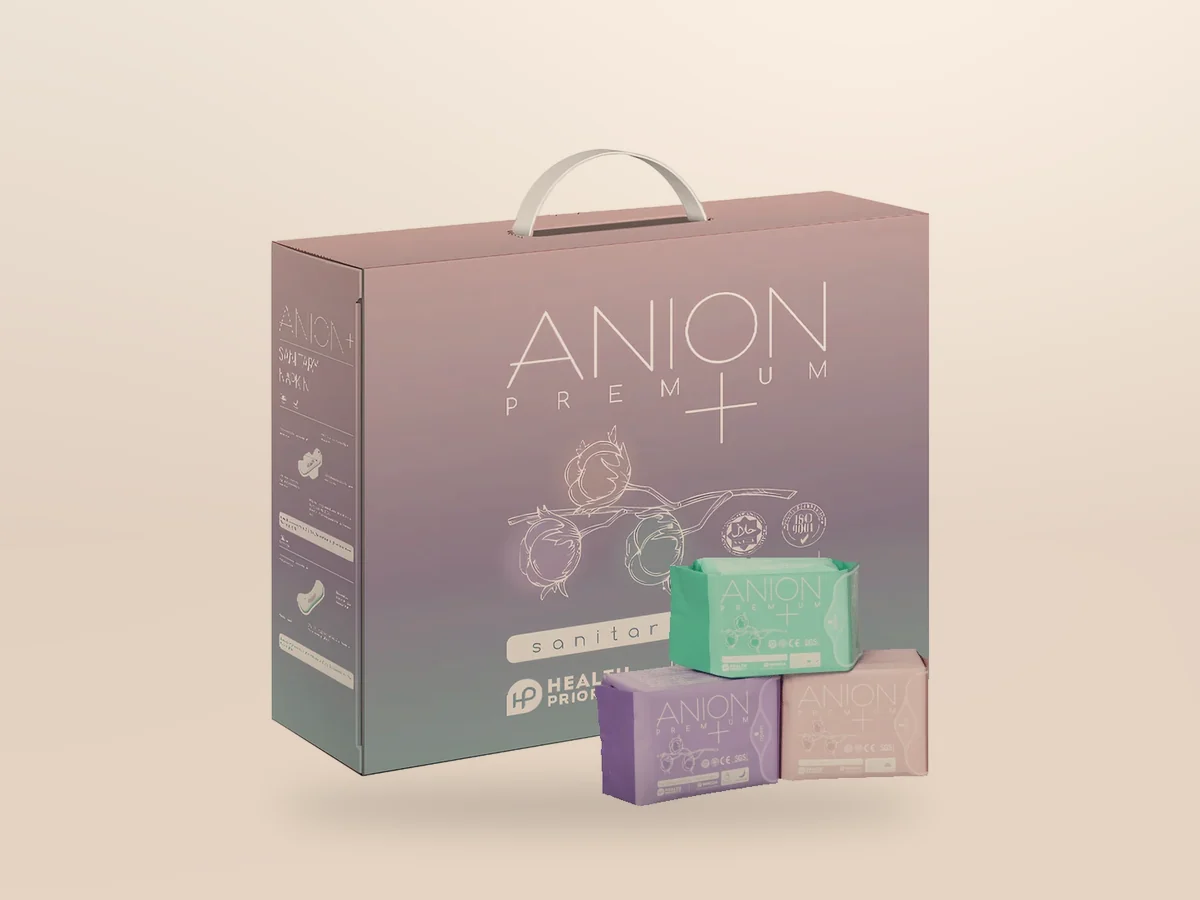
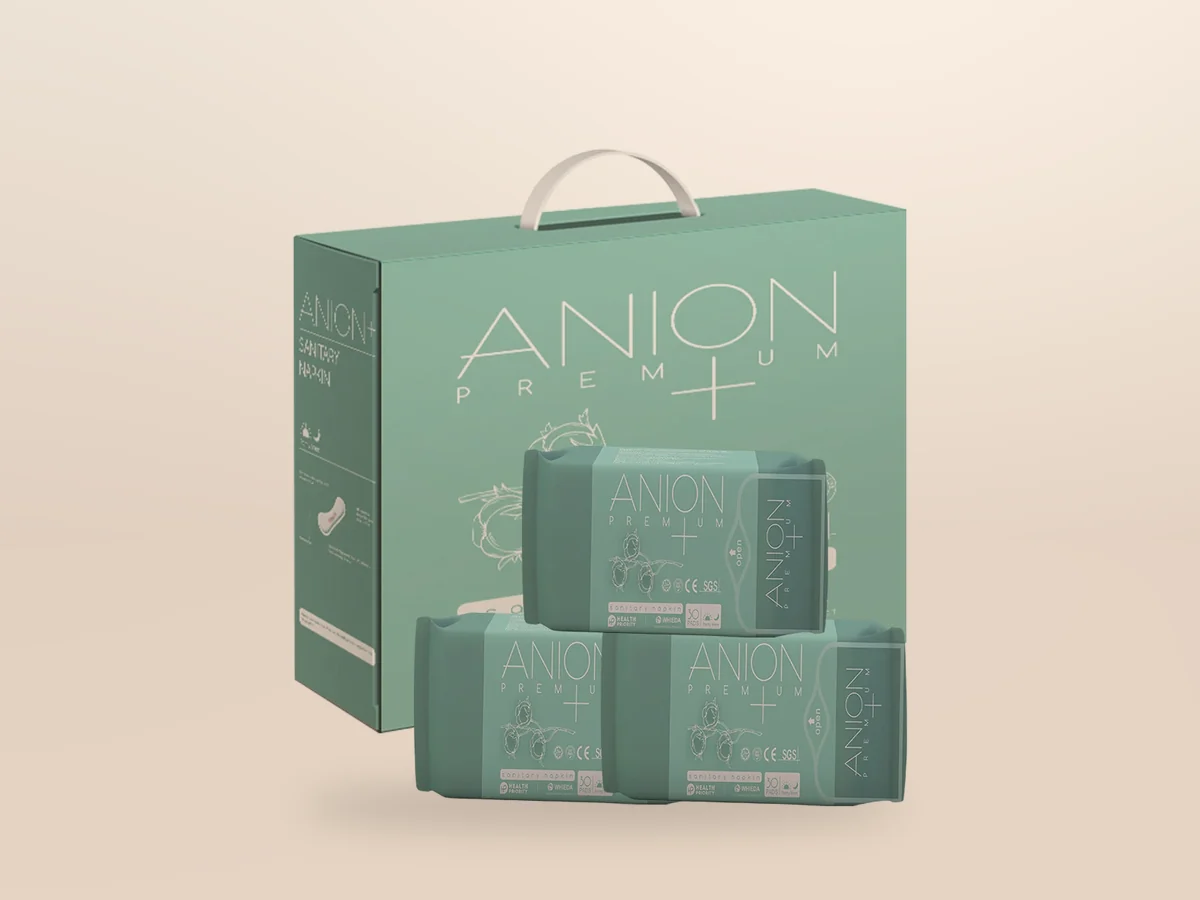
The box is put together for several cycles ahead: 19 packs of three kinds, all with the same chip.
Day pads
10 packs of 10: 100 pads.
Night pads
4 packs of 8: 32 pads for the night.
Panty liners
5 packs of 30: 150 pads for the days between cycles.
That’s what one pad comes to: the box costs 7 000 ₽, and there are 282 inside.
Individual intolerance to the components. Stop use if significant irritation occurs.
RU.01.PA.02.012.E.000053.09.24Day and night
State registration certificate dated 25 September 2024, with no expiry date. Issued by the Rospotrebnadzor Office for the Republic of Adygea. Open PDF ↗
RU.01.PA.02.012.E.000052.09.24Panty liners
A certificate from the same day, also with no expiry date. Open PDF ↗
Since 2023Officially in Russia
The new certificates replaced the original ones from March 2023. These pads have been sold officially in Russia since at least 2023.
РОСС RU.32776.ОС01.00398Halal certificate
For day, night and panty liner pads. Valid from 2 October 2024 to 1 October 2027. Issued under the voluntary certification system “Chisty Produkt” (Pure Product), which is listed in the Rosstandart register, “taking into account the strict rules established by the Islamic religion”. The pads are recognized as “Halal products”: the mark may be placed on the packaging, and compliance is confirmed every year by inspection control. Open PDF ↗
Who's who: the pads are made by the Foshan Yurun Sanitary Article factory in Foshan, Guangdong Province. WHIEDA imports and sells them in Russia and the CIS.
What's in the box?
19 packs of three kinds, 282 pads in total. Day pads: 10 packs of 10; night pads: 4 packs of 8; panty liners: 5 packs of 30. The packs come in three colours: mint, lilac and pink.
Are panty liners available separately?
Yes, as a case of 16 packs. Panty liners are for the days between cycles: they have six layers, they're thinner and lighter, and the chip is the same. panty liners page →
Are they suitable for sensitive skin?
Cotton rests against the body, and the backsheet breathes. The state registration certificate includes a hygiene table: skin irritation and allergenicity are both recorded there with an index of 0.
When will I notice the difference?
Dryness — from the very first pad: the gel draws moisture in right away. To compare fairly with your usual pads, give them one full cycle.
Nine layers where a hundred years ago there were forty, and the empresses' warm stone right against your skin.
The box of 19 packs, 282 pads, costs 7 000 ₽, about 25 ₽ a pad. You can check on the product card whether it’s in stock right now.